MODULE 1.
Meet the Fleet
Aim:
Introduce new crew to the Sydney Heritage Fleet and James Craig.
Overview:
The Sydney Heritage Fleet
Brief description of James Craig
Requirements to become a crew member in James Craig
Outline of crew training programme
Training syllabus
Crew obligation to participate in maintenance
Crew ranking system
Ship’s layout
Ship’s facts and figures
Outcome:
Crew will gain an appreciation of the Sydney Heritage Fleet’s operation and a foundation for becoming a crew member in James Craig.
Sydney Heritage Fleet
The Lady Hopetoun and Port Jackson Marine Steam Museum, the forerunner of the Sydney Heritage Fleet, was founded in 1965 by a group of public-spirited individuals to preserve Sydney’s 1902 VIP steam launch Lady Hopetoun. The organisation later became known as the Sydney Maritime Museum Limited. In 1998 the museum adopted the trading name Sydney Heritage Fleet and later, Australian Heritage Fleet. In 2004 the Museum reverted to Sydney Heritage Fleet. The Fleet now comprises 8 operating historical vessels, which is amongst the largest such collection in Australia.
A community-based non-profit organisation, the Fleet’s mission is to build and maintain an internationally recognised centre of excellence in maritime heritage for the benefit of all Australians by presenting through research, acquisition, conservation, restoration, education and operation, our continuing maritime history. The Fleet is funded through donations, membership subscriptions, income from vessel charters and tours and the proceeds of Art Unions.
The Fleet’s 1000+ membership, including over 650 dedicated volunteer workers, restore, operate and maintain the fleet of vintage vessels. In the process they preserve traditional technical methods and skills.
The Fleet’s oldest vessel, the 1874 iron barque James Craig, has been fully restored and regularly puts to sea under full sail. The Fleet also operates three of the most historically significant vessels on Sydney Harbour: the 1902 steam tug Waratah, the 1902 VIP steam launch Lady Hopetoun and the 1903 schooner Boomerang.
Other operational vessels include: Protex, the 1908 inner-harbour motor launch; Harman, the 1947 ex-RAN harbour workboat/passenger motor boat; Berrima, the 1954
Botany Bay general workboat/passenger motor boat; Kookaburra II, the 1954 wooden speed boat.
Under restoration are the 1912 ferry Kanangra, and the 1927 coastal steam tender John Oxley.
The Fleet also has 55 small heritage boats and one of the largest collections of marine engines in Australia, which are being restored and conserved. The Fleet’s collection includes more than fifty model ships, including models of some of the Fleet’s own vessels.
The Fleet maintains a comprehensive research library/archive, which includes photographs, ships’ plans, diaries, logs and journals.
The Sydney Heritage Fleet made significant contributions towards the establishment of the Australian National Maritime Museum, which opened at Darling Harbour in 1991. Whilst the two organisations differ, they do play complementary roles, the Sydney Heritage Fleet placing an emphasis on preservation, restoration and operation of heritage vessels.
Description Of James Craig
James Craig is a three masted Barque of approximately 1500 tonnes displacement with an overall length of 70 metres.
The ship and others of the era were designed to carry cargo quickly and safely around the world. They are principally ‘down wind’ ships with limited ability to point high into the wind.
During your training you will gain an understanding and appreciation of how the ships were operated and handled to achieve the operators’ goals.
Refer to page 5 for the ship’s layout.
Refer to page 6 for some of the ship’s facts and figures.
Requirements To Join The Crew
Join the Sydney Heritage fleet. Membership entitles crew to access all the numerous activities and benefits of the fleet.
Attend a Fleet Discovery Day to gain a broad appreciation of the Fleets activities.
Minimum age 16
Complete the James Craig crew application form.
Have your Doctor complete the Sydney Heritage Fleet Medical Assessment form. If you are the holder of a current Australian Maritime Safety Authority (AMSA) medical, this is acceptable.
Complete the training kit order form. The Kit you purchase covers a hard copy of this Handbook, A Diary of Service and Experience Log Book, Access to online units, Day Sail, materials and administration of the course.
Complete Online introduction units then;
Attend alongside practical training course aboard James Craig followed by a
mentored day as sea as a crew member.
Participate in ship maintenance.
On satisfactorily completing all introduction modules (1 to 11) and a day sail, new crew will be placed on the ship’s crew list. They will then be able to put their name down for crew duties as a ‘Deck Trainee’ on sailing days, harbour sails etc.
If you have an e-mail address, and you wish, you will be forwarded communications on coming sailings and events. The alternative is to contact the ship’s Crew Coordinator via jccrew@shf.org.au ..
You can undertake further crew training and have your efforts signed off in your ‘Diary of Service and Experience Log’ book to progress through the ranks.
The James Craig is a commercial vessel. Therefore, you are required to eventually complete the NSW Maritime General Purpose Hand course.
This course is conducted by TAFE or OTEN. When there is a sufficient number of members’ wishing to do the course the Fleet may be able to arrange for OTEN to conduct the course in-house. The alternative is to approach these organizations direct.
Training Programme
Sailing the James Craig is a practical skill developed by participation. The contents of this manual are designed to provide support to assist crew understand and improve their skill.
To encourage and acknowledge skill levels reached in the crew, a system of ranks has been developed. Refer to diagram on page 4.
To become eligible for progression in rank to Deck Hand, Efficient Deck Hand, tasks set out in the ‘Diary of Service and Experience Log’ book must be completed and signed off by an appropriate crew member or officer.
Copies of the ‘Diary of Service and Experience Log’ book are available from the Training Coordinator.
Training Syllabus
Modules 1 to 11 plus a day at sea are designed to introduce new crew to the James Craig.
These, plus additional modules containing more specialised information on a variety of topics relating to the ship, can be used by all to improve their knowledge.
The modules are continually being reviewed to comply with changes in procedures, therefore they have been dated. To enable you to check for changes, a copy of current Modules can be referred to in the ship’s copy of the James Craig Crew Handbook, which is kept on board the ship.
MAINTENANCE
The James Craig is a working ship and therefore requires constant routine maintenance.
All crew members are expected to participate.
Maintenance groups meet mainly at weekends with others doing work during the week. The ship’s manager, with volunteer co-ordinators, organise the roster and tasks.
Participation is also a good opportunity to learn more about your ship and meet other members of the crew.
JAMES CRAIG TRAINING PROCESS AND RANKS
JAMES CRAIG LAYOUT
This map will assist you find your way around the ship.

Main and Anchor Decks
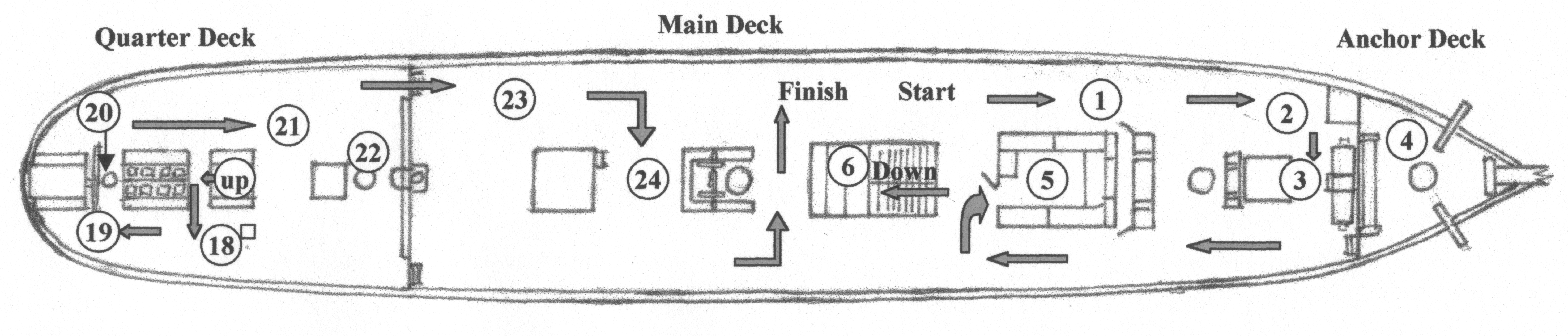
Stations; 1. Galley 2. Head 3. Windlass and Bell 4. Capstan 5. Deckhouse 6. Proceed down stairs to t’ween deck.
‘Tween Deck (Holds and Officers quarters)
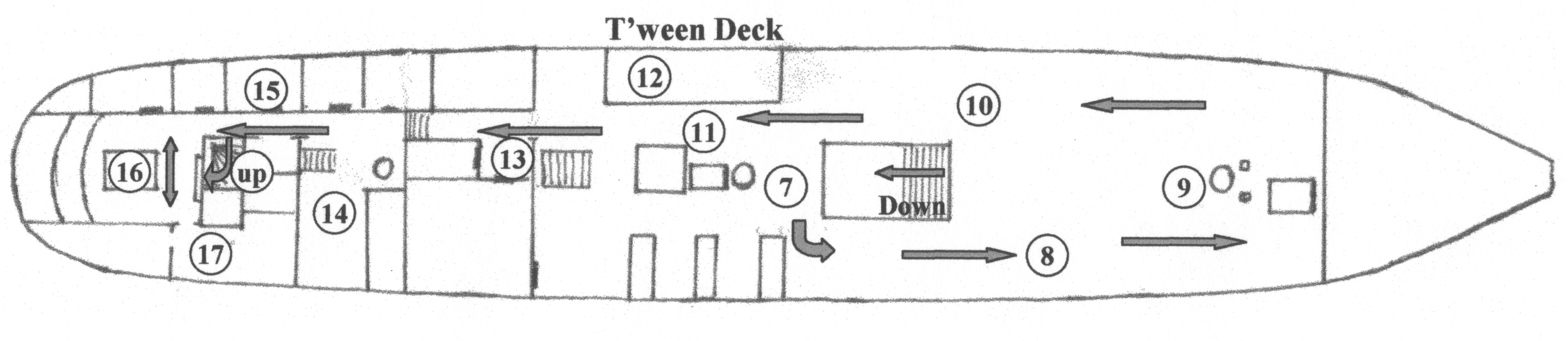
Stations; 7. Main hold 8. Main hold 9. Awards 10.Audio visual display 11.View into lower hold and water tank.
12.Berths 13.Toilets, “galley” and engine room access. 14.Bosun’s locker. 15.Officers cabins 16. Saloon 17.Captains cabin
Stairs up to the quarter deck.
Quarter Deck and Main Deck (Follow arrows on first map)
Stations; 18. Engine controls 19. Helm 20. Compass binnacle 21. Cabinet work 22. Bell 23. Main deck 24. Fife rail & bilge pump.
JAMES CRAIG FACTS AND FIGURES
Former Names Clan Macleod
Launched 18th February, 1874 by Bartram Haswell & Co. Sunderland England
History Thomas Dunlop (Scotland) 1874 to 1887 (Clan Macleod)
Sir Roderick Cameron (Scotland) 1887 to 1900 (Clan Macleod)
JJ Craig, Auckland 1900 to 1911. Renamed ‘James Craig’ 14/12/1905.
British New Guinea Development Company 1911-1918
Henry Jones IXL 1918-1925.
Catamaran Coal Mining Co (Recherché Bay, Tasmania) 1925-1930’s.
Scuttled Recherché Bay early 1930’s-1972.
Re-floated 5 am, 24th October, 1972.
Towed to Hobart 7 am, 26th May, 1973 by tug “Sirius Cove”.
Powder Wharf, Hobart (sank once) 1973-1981.
Towed into Sydney Harbour, January 1981
Official Number 68086
Signal Letters VJMR
Propulsion Original 3-masted Barque rig
Restored 3-masted Barque rig plus 2 x 400hp MTU diesel marine engines and ZF Marine model IRM 350 gearboxes with reduction ratio 6:1
Tonnage Approx 1.500 tonnes loaded displacement – registered tonnage 646 tonnes.
Length 54.7 metres
Length Overall 70 metres from flying jib boom to mizzen boom
Beam 9.5 metres
Draught 3.7 metres
Depth of Hold 5.5 metres
Masthead Height 33.0 metres above deck. 35.0 metres above waterline (higher than the deck of the Anzac Bridge @ 27 metres)
Fore lower mast (iron) 19.4 metres stepped on keel
Main lower mast (iron) 20 metres stepped on keel
Lower yards (iron) 19.2 metres (weight 1.4 tonnes)
Original Crew Master, his wife, 16 crew including 3 apprentices
Number of frames 92
Number of plates 424
Number of rivets 50,000 (approx.)
Metres of planking 1000 (approx.)
First Landfall in Australia 5th voyage, Brisbane, 1879
Trans Tasman run 35 round voyages
Typical Cargo Coal, kerosene, general cargo, timber, wool
Length of standing rigging 5000 metres
Total number of sail 21
Total sail area 1100 square metres when fully rigged
Cape Horn Roundings 23
Original Cost Eleven Thousand, Three hundred and Seventy Five Pounds
Funds raised/spent to date A total of AU$6,000,000 since 1973 in dollars of the day, including an estimated AU$800,000 worth of gifts
in kind. Plus countless hours of voluntary assistance